What do the Jews of India call Passover ‘The holiday of the covered clay pot with the sour liquid’?


Indian clay pot Image by Yawar Nazir/Getty Images

What do the Jews of India call Passover ‘The holiday of the covered clay pot with the sour liquid’?

The Bene Israel, India’s largest Jewish community, doesn’t call Passover Passover. The word in their language, Marathi, is “Anashi Dhakaicha San,” which means “The Holiday of the Closing of the Anas.”

San is the word for holiday, and anas refers to a sour liquid in a pot.

It makes sense that the Marathi word for Yom Kippur is “Darfalnicha San, or “The Holiday of the Closing Doors,” since Bene Israel fast in their homes behind shut doors — the first Bene Israeli synagogue wasn’t built in Mumbai until 1796.

But the mystery behind The Holiday of the Closing of the Sour Liquid in a Pot takes a bit more explanation.

The first mention of Anashi Dhakaicha San appears in “The History of the Bene Israel of India,” a book in English by the renowned Bene Israeli community leader and historian Haeem Samuel Kehimkar, who lived from 1830 – 1909. This first historical manuscript about the Indian Jewish community living in Mumbai and its surrounding villages on the Konkan coast was written in the nineteenth century. It was kept hidden in the family’s possession for 40 years after Kehimkar’s death. The manuscript was given to Dr. Immanuel Olswangner, a researcher of the Indian Jewish communities, and was published in 1937 in Tel Aviv.

In “The History of the Bene Israel of India,” Kehimkar writes, “From the 14th of Nissan they observed for eight days a holiday called Anasi Dhakacha San i.e. ‘the holiday of the closing of the A n a s (an earthen chatty, containing sour liquid used as a sauce). They abstained from using the sour liquid, as well as any leaven, during the period of the feast. On the 23rd of the month they uncovered the chatty, and used leaven as before.”

Earthen chatty is a clay pot. That is how Dr. Olswangner referred to Passover as “The Holiday of the Covered Pot” in “Travel Impressions,” his India travel diary notes published in 1936 in Hebrew by now-defunct Israeli publication Davar.

Israeli-Indian Jew in Mumbai Unearths the Spice of Her Life

Photo ©ShulieMadnick

Israeli-Indian Jew in Mumbai Unearths the Spice of Her Life

Little did I know, when my Indian-Israeli aunt insisted on visiting a certain spice shop during my visit to Mumbai, that it would be in the Lalbaug spice bazaar. I had marked the bazaar as a must visit on the Google map I “drew” while planning my trip to India. Like my aunt, many Indian Israelis visit this shop when they land in Mumbai. Lalbaug, the neighborhood, is also my dad’s old stomping ground.

It was a rainy day, the last of the monsoons. Our large hotel umbrellas were threatening to poke people in the eyes and get entangled in the protective tarps above the merchant’s stalls that line the narrow sidewalks, and strip them right off. A self-appointed English-speaking guide accosted us as soon as we entered the market. My aunt, for the second time in two days, was yelling in Marathi (the language of the state of Maharshtra), resisting this stranger’s relentless attempts to steer us in the direction of his friend’s shop. The first “volunteer” guide had been shooed away by my aunt the day before, at the Crawford vegetable and fruit market to the South of Lalbaug’s bazaar. This time, the umbrella was her tool and prop of intimidation, a sword and a baseball bat in one. Bollywood couldn’t have scripted a better animated drama.

We searched for this particular wholesaler, which doubles as the retail spice shop that my aunt knew of, walking up and down this one lane several times. When I gave up and turned towards the main spice-shops drag, with displays of perfectly colorful spice mounds, my aunt disappeared. Turns out we didn’t walk far enough. She found the shop up at the corner. We proceeded to deplete everything in sight.

Indian Shakshuka

Photo: ©Shulie Madnick

My happiest memories of my father are of mid afternoon Fridays, the only time we would find him in the kitchen. A flock of six kids, like turtles making their journey back to the sea, trekking back home tired and famished on mid afternoon Fridays.

A couple of my younger siblings, walking a few miles back home from school, moments ago just jolted out of their seats in their classrooms, at the much awaited sound of the bell signaling the end of school week and freedom.

Another brother or a sister, stepping back home, dusty from an excursion on the patchy green, mostly sandy play area or from a playful ride outside on our lone brand new bike. I am hitchhiking in the scorching sun, from my army base somewhere in central Israel and heading home south, after an entire week or two of being away. Us all famished and cannot wait for Friday night Shabbat dinner.

While my mother scurries in her small kitchen, in the midst of preparation of a traditional Indian Shabbat dinner, she allots one burner for my father and his mid afternoon Friday attempts to ease our hunger and soothe our stomachs, with his claim to culinary fame, shakshuka.

I enter our home to the sights of windows and doors wide open, sheer curtains are standing still, longing for a late afternoon, early evening, cool Mediterranean sea breeze, and aromas of my father’s, made to order, Shakshuka or my sisters rolling out, thin crust pizza doughs. Scents of quintessential North African cuisine flow through our wide open windows from our Moroccan neighbors’ preparations of a traditional Friday night couscous, instead of the elusive cool sea breezes.

My father, a jokester, would cook on those Fridays with much ceremony, air and laughter. Kidding around and playfully teasing us all the while. Not letting us dig into the dish or hurry the process. He was meticulous. We would beg for him to hurry but he liked the shakshuka just so, just like his tailored made pants and button down shirts, perfectly measured by a neighborhood tailor nearby.

I share with you an Indian version of the shakshuka , poached eggs in curry sauce. Curry powder is a blend of fresh spices that usually consists of some if not all of these ingredients: red chili pepper, turmeric, black pepper, cardamom, coriander, cumin, ginger, clove, cinnamon, fennel, mustard and more. The ratio and proportion of the curry spice blend widely varies from state to state in India, region by region and from one household to another based on the dish you cook and personal preference. Nowadays you can find curry powder in any mainstream supermarket in the United States or in your neighborhood Indian grocers if you happen to live in or by a major metropolitan area. For the purposes of this recipe a straight forward curry powder from the spice isle in your nearby supermarket will do wonders with this shakshuka.

Indian Shakshuka — Poached Eggs in Curry Sauce
2-4 servings

4-6 eggs
4 tablespoons canola oil
1 large onion, diced

Vada Pav; Fried Potato Sliders, A Spicy Mumbai Street Food Make Festive Latke Substitute

Image iStock

Vada Pav; Fried Potato Sliders, A Spicy Mumbai Street Food Make Festive Latke Substitute

I had only two days left in Mumbai before flying back home to the U.S. (with a few days layover in Tel Aviv, where I was born and raised). I had pretty much checked off all the boxes on my Jewish-Indian heritage discovery trip to India. I’d visited almost every single active synagogue in this chaotic, yet somehow familiar, city of 20 million, which my parents called home until their 20s when they emigrated to Israel.

My list of Mumbai food musts, on the other hand, still remained a mile-long — with so little time left to explore.

Swati Snacks, a super hygienic, vegetarian Indian street food restaurant, was where I was going to “quench” my Mumbai street-food “thirst.” (I wouldn’t brave the street-food carts and stalls in order to satisfy my cravings.)

Swati Snacks is located in south Mumbai, not far from the awe-inspiring Mani Bhavan, Gandhi’s Mumbai headquarters and residence-turned-museum. Little did I know that I would go back to Swati for every meal of my remaining 48 hours, over order each time, and still yearn for more.

At Swati Snacks I ordered the quintessential Mumbai street food, the vada pav. A potato dumpling made with lightly mashed potatoes, the chunky mash is spiced with turmeric, fresh curry leaves, black mustard and cumin seeds, along with cilantro and green chili pepper, then it is dipped in chickpea flour batter and fried. The fried dumpling is then plopped on a Parker House-like roll and slathered with green- and red-pepper chutneys. The result is a dish of sinful mini “sliders” — carb on carb action — served as a trio.

It remains a mystery to me why I haven’t included the vada pav, a seemingly obvious Indian substitute for the Ashkenazi latke, in my eclectic, Indo-Mediterranean Hanukkah-gathering menus! (Though the thought always crosses my mind when December comes around each year.)

Batata vadas are made year-round. Traditionally at home they are served just as dumplings (batata vedas) without the buns (pavs). Although it’s not a traditional Jewish Indian Hanukkah dish, I am surprised it wasn’t adapted as one when the community learned about the holiday.

Hanukkah came to the Bene Israel (Sons of Israel) Jews in India (who were isolated from the rest of the Diaspora) much later than to other Jewish communities around the world, since they left Israel before the rededication of the 2nd Temple. They only had the first five books of the Bible, not the writings after.

Christian missionaries, in failed attempts to convert the community, and a Malabari (Cochini) Jew named Rahabi, were fundamental in teaching the Bene Israel Jews Hebrew and “modern Judaism.” There are several accounts of Rahabi’s arrival within the Bene Israel, but the date of his arrival is unknown, with accounts ranging between 1100 BCE and the 18th century.

A Family Recipe For Vada Pav

(An Indian, gluten-free, spiced potato dumpling in chickpea batter on a bun).

This deep-fried spiced potato dumpling in chickpea batter is called batata vada when served without a bun — as it commonly is when made at home — and vada pav when served with a bun, when eaten as street food. Specialty ingredients such as black mustard seeds and curry leaves can be found at your local Indian grocer, many mainstream supermarkets, or online. The bun is also traditionally smeared with gun powder when eaten as a street food. At our home, it was served with green chutney and tamarind chutney without the buns.


Makes one dozen
3–4 medium (1–1¼ pound) Yukon Gold potatoes, peeled and quartered
4 tablespoons vegetable oil
1–2 green chilis (or jalapeños), stemmed, halved lengthwise, and thinly sliced

Milk Halwa for Rosh Hashanah


Copyright ©ShulieMadnick
 
Halwa is a traditional Indian milk custard made by the Bene Israel Indian Jews in Mumbai for Rosh Hashanah. In India halwa is made with “chick,” a wheat gluten, but in Israel, a majority of the community is using cornstarch as a substitute, at times together with China grass (agar-agar). The recipe can be made with either milk or coconut milk diluted with water. At home growing up, my mom always made it with whole milk — as I continue doing every Rosh Hashanah. This year, I might make it with coconut milk inspired by "How A Mumbai Cook Prepares For Rosh Hashanah.

This recipe and article "Flavors of an Indian-Israeli Rosh Hashanah" were originally published in Haaretz English edition on September 8, 2015.  In an effort to curate my articles and recipes in one space, I  republished the article and recipe in this space. 

Look at the rosy halwa reel I made a year ago here, my son  and a yellow "turmeric" halwa reel I made over  two and half years ago here

How A Mumbai Cook Prepares For Rosh Hashanah

Copyright ©ShulieMadnick
This article was originally published in The Forward on September 15, 2017. To curate my articles in one space, I am republishing it here just before Rosh Hashanah eve, falling on September 18, this year. Watch the recipe prep video at the bottom shot in Mumbai by me and edited by Amy Sawyer (Smoky Leo). All copyright material © ShulieMadnick. Please do not copy or republish without permission. A link to this post can be shared.

How A Mumbai Cook Prepares For Rosh Hashanah

On the morning of Rosh Hashanah Eve 2016, I met Sharona Hayeems, a local Indian Jewish caterer, at her home in Dadar, a neighborhood in Mumbai where some of the remaining 4,500 Indian Jews in India still live. I was there to spend some time watching her cook for Rosh Hashanah.

I was introduced to Hayeems, a Bene Israel (Sons of Israel) Indian Jew, by the inimitable Elijah Jacob, the India executive director of the American Jewish Joint Distribution Committee (AJDC). Hayeems prepares kosher meals for Meals on Wheels, a program subsidized by the AJDC and Indian Joint Trust, which feeds the less fortunate in the Jewish community throughout the year, according to David Kumar, India AJDC welfare manager.

Lamb Biryani for An Indian Passover ( & Rosh HaShanah)

 The Layers of Lamb Biryani (Rice, Lamb, Rice, Garnishes) Copyright ©ShulieMadnick

The crown jewel in my mom's culinary arsenal is this luxurious, aromatic lamb biryani. Only the regional biryanis I have had in India lived up to my mom's. The Mumbai biryanis made me think of how my mom, who still several decades later, manages to preserve the flavors and encapsulate the essence of Maharashtrian cuisine in Israel.

This sensational lamb biryani is at the center of the Bene Israel Indian Jewish Community's Passover holiday table. The rice is infused with saffron and then layered with the curry-spiced leg of lamb and garnished with cashews, raisins, crispy onions, and cilantro chips. The juxtaposition of sweet and savory flavors, crunchy and soft textures and many colors create a festive dish that is a Bene Israeli Passover (and Rosh HaShanah) tradition.

Biryani is originally from Persia. It was brought to India by the Arabs and Mongols. Over the centuries, the native Indian communities adapted the dish and made it their own. Although ghee, clarified butter, and yogurt are often used in the dish, Indian Jews replaced those dairy ingredients with vegetable oil to create a kosher rendition.

"Biblical Rituals and Passover Traditions of the Bene Israel, India's Largest Jewish Community," published in Haaretz newspaper in 2016 and re-edited and curated here, explores further the Bene Israelis foods of Passover (in India, the community primarily used goat meat). The article also explores the community's over 2000 year history in India and its unique Passover traditions. 

Author's Notes:

1. Allergen alert: Those with a tree-nut allergy can leave out the cashews or substitute them with peanuts. 

2. Some of the preparations for this dish can be made a couple of days in advance. The entire dish can be fully assembled the day of. This recipe is long, but the steps are not particularly difficult. The end result is well worth the effort. 

3. At times, my mom also makes this biryani with a layer of potatoes at the bottom of the pot. The potatoes get crisp and golden, similar to the potatoes in the Persian tahdig. She then flips the pot into a serving dish for a showy presentation. I might share a simplified version of biryani with potatoes in the future. 

4. I edited this recipe since, in versions published in both the Forward and the Hadassah Magazine, I used garam masala to make the process easier. My masala mix for this biryani contains 13 spices. I make a large batch and save it in the freezer. It can get costly and time-consuming, especially if you don't cook Indian food often. To make life easier and lower the cost, I suggest you buy a ready-made curry mix. Either a chicken/meat masala or a biryani one. Bonus points if you score masala from the State of Maharashtra, which Mumbai is its Capital. The dry masala mix recipe I will share one of these days.

4. In this method, I fully cook the rice and not cook it al dente in water like pasta, then finish it off layered in the pot with the lamb covered in the oven, not over the stove. I will share the al dente method when I share the simplified biryani (or tahdig) with the potato layer at the bottom (see number 2).

5. You can add more cashews, raisins, cilantro leaves and onions, depending on taste. Just make sure to fry them (see directions below).

Lamb Biryani

Lamb Ingredients

2.2 pounds deboned leg of lamb, cut into small/medium-sized cubes
Water to cover
1/4 - 1/2 tsp salt
2 - 3 bay leaves
8 -10 cloves

Chasing Challah in Mumbai


Copyright ©ShulieMadnick
This article was slightly tweaked from the original version published in The Forward on January 17, 2017. To curate my articles in one space, I am republishing it here just before Rosh Hashanah eve, falling on September 18, this year. All copyright material © ShulieMadnick. Please do not copy or republish without permission. A link to this post can be shared.

You can read How A Mumbai Cook Prepares For Rosh Hashanah from the Rosh HaShanah and High Holidays series.

Chasing Challah in Mumbai

It was the break of dawn on a Thursday, as the monsoon waned in late October that we descended from the skies over the slum rooftops and landed at Chhatrapati Shivaji International Airport in Mumbai. My travel companion and I were then whisked off by our lovely Indian Jewish tour guide, Hanna Shapurkar, to Om Creations.

Om Creations is a nonprofit center where Down syndrome and autistic adults are taught arts and crafts and some culinary skills. The crafts and food are, in turn, sold as a means of support and income for the participants.

While still back home in the United States, planning my Jewish-Indian heritage discovery trip to India — my first trip to my parents' homeland — little did I know that I would be visiting Om Creations. What sparked my interest was an inconspicuous mention in an email correspondence from Elijah Jacob, India executive director of the American Jewish Joint Distribution Committee (JDC), about delivering challahs to the Indian-Jewish community in Mumbai. I was so intrigued that chasing challahs became the end-all and be-all of my trip to India.

Flavors of an Indian-Israeli Rosh Hashanah

Magen Hassidim Synagogue, Mumbai, India Copyright ©ShulieMadnick
This article was tweaked from the original version published in Haaretz Newspaper on September 8, 2015. In an effort to curate my articles in one space, I am republishing it here just before Rosh Hashanah, falling on September 18, this year. All copyright material © ShulieMadnick. Please do not copy or republish without permission. A link to this post can be shared.

You can read How A Mumbai Cook Prepares For Rosh Hashanah and Chasing Challah in Mumbai from the Rosh HaShanah and High Holidays series. Recipes for both biryani and halwa will be published in separate posts.

Photography during the holidays is forbidden so I am sharing a snapshot of Magen Hassidim (above), my mom's synagogue in Mumbai, where I spent the 2016 High Holidays. This image, among others, is archived on The Museum of Jewish People's (בית התפוצות) library archives in Tel Aviv, Israel.

Flavors of an Indian-Israeli Rosh Hashanah

The first inkling that Rosh Hashanah was approaching when I was growing up was when my mom would come home to our fourth-floor walk-up apartment in Ashdod with Lily Pulitzer-like floral fabrics. I dreaded the frocks and matching hair bows that an Indian seamstress would sew us from the textiles. I would walk in the intense heat with my mom and my sister, who is a year younger than I, to the seamstress' home a few neighborhoods over for the measuring and fitting, and again for a second fitting and minor tweaks. My mom would definitively proclaim that the scraps and leftover fabrics "were enough" for my two youngest sisters' Rosh Hashanah gowns.

Marzipan Almond Challah Crown


Marzipan Almond Challah Crown ©ShulieMadnick

This sublime Marzipan Almond Challah Crown recipe first appeared in Bonnie Benwick's "How to make your challah lovelier and sweeter for the Jewish New Year," published in The Washington Post on September 8, 2015. I am republishing the Marzipan Almond Challah Crown recipe, with some edits, just in time for Rosh HaShanah 2021 falling on the eve of September 6 this year.

I baked with then Deputy Editor of the Washington Post food section, Bonnie Benwick, some of my challahs at her home that year before Rosh HaShanah. And amidst the couple of tumultuous years we had with COVID-19 and the looming Delta variant, these are much needed feel-good quotes and testimonials I re-visited from Bonnie's article above: 

"The Washington area food blogger and travel writer bakes challah every Sabbath, as was the practice in many of her friends’ homes when she was growing up in an Indian-Israeli community in Ashdod, south of Tel Aviv. Looking to complement her Rosh Hashanah dishes — lamb biryani, veal-and-beef-stuffed artichoke bottoms in a spicy red sauce and the cornstarch-thickened, sweetened milk custard called halwa — Madnick figured out a way to capture fruit and/or nut fillings within each rope of dough. She braids those ropes in such appealing ways as to create almost a new class of High Holiday challah."

"Madnick worked on her base challah dough over many years. It’s not too eggy and, like others, not so fussy. Her flavor combinations can be seasonal: apples and quince in the fall; cranberry, orange and nigella seeds in the winter; cherry and oats in the spring. Rosh Hashanah stuffed challahs call for something sweet: chopped dates, fresh figs, even marzipan. Each sub-portion of dough that might have been a simple rope in a braided loaf of challah is first rolled out to a thin rectangle, then swabbed lightly with a syrup or jam to help hold the chopped fruit or nuts in place. Once the dough is rolled up, the filling stays contained, allowing for the usual braiding and shaping."

"Except Madnick’s techniques rise above the norm, appropriately. She’ll do a four- or six-part braid, winding it in on itself like a nautilus.."

Honey Challah

Honey Challah photography © ShulieMadnick
I realize that, with some exceptions, I have many challah recipe riffs on this site that are based on my basic honey challah recipe.  I published the original honey challah recipe many years ago, as a guest blogger, on Indonesia Eats. I would like to share a slightly tweaked honey challah recipe here since my recipe testing and writing improved in over a decade, so we have a honey challah baseline on Foodwanderings. You can get creative with the toppings and even fillings. For fillings, first, check out some of my other filled and stuffed challahs for directions. Please find links to my published challahs on this site, the Washington Post, etc., at the end of this post.

Quince Challah Knots

Quince Challah Knots ©Shutterstock

I first published this Quince Challah Knots recipe in The Washington Post Lifestyle and Food sections on October 6, 2011, under the 'Challah with Quince, an Unexpected Holiday Treat' headline. With some edits, I am republishing the Quince Challah Knots recipe just in time for Rosh HaShanah 2021, which falls on the eve of September 6 this year. 

Turns out, I initially baked these delicious beauties for Yom Kippur break-the-fast 2011, but they are a real treat for Rosh HaShanah as well. 

My son was still in High School and I completely forgot that I used him and his soccer buddies as my guinea pigs. And below is what I wrote back in 2011 for The Washington Post:

Challah with Quince, an Unexpected Holiday Treat

For our Yom Kippur break-fast this year (which will take place Saturday night), I was looking for an alternative to my usual apple-filled challah when I hit upon using quince, the firm-fleshed fruit sometimes known as golden apple. It can smell of pineapple or guava, and it looks a little like a plumped-up pear.

Date, Walnut, Silan and Sesame Challah

Date, Walnut, Silan and Sesame Challah ©ShulieMadnick

The Date, Walnut, Silan and Sesame Challah recipe originally appeared in Bonnie Benwick's  "How to make your challah lovelier and sweeter for the Jewish New Year," published in The Washington Post on September 8, 2015. I am republishing the Date, Walnut, Silan and Sesame Challah recipe, with some edits, just in time for Rosh HaShanah 2021 falling on the eve of September 6 this year.

In the Marzipan Almond Challah Crown recipe and post I published recently, I shared some feel-good quotes and testimonials written by Bonnie in the article above. Here I would like to share some of the heartwarming feedback on the Date, Walnut, Silan, and Sesame Challah recipe shared by a reader who baked it:

In 2015: 

"The Eastern Shore is a fancy food desert. I had no hope of finding silan out here, so I substituted golden raisins and walnuts. The bread came out great, and I also thank you for teaching me a new braiding technique. I usually do the long four-strand braid.

Tonight, I happen to be in Nashville, and there's a Middle Eastern market less than a mile from my hotel. So I went in there, showed the proprietor a picture of the product, and he took me to...a display of strawberry jam. Is it possible a Middle Easterner doesn't know what silan is? If someone here knows where in Maryland to get this stuff, maybe Wegmans, I'm all (virtual) ears. Nashville's Whole Foods didn't have it, either, which I was surprised at."

Quince Jam

Copyright ©ShulieMandick
Pomegranates and apples are the epitome of the High Holidays season but to me the rose-colored quinces' jam with cinnamon and cloves is the first sign of the fall season. 

This recipe for Quince Jam was initially published on September 23, 2014, as a part of a collection of recipes in an article I wrote for break-the-fast on Yom Kippur for The Washington Post. I am republishing it here, slightly tweaked, just before Yom Kippur eve, falling on September 27, this year. Stay tuned for the article and other recipes for break-the-fast in the series re-published soon. All copyright material © ShulieMadnick. Please do not copy or republish without permission. A link to this post can be shared.

Serve with challah or Tunisian Bulo (similar to Mandelbread).

No-Bake Blueberry Cheesecake

This story and recipe were originally published in The Jewish Food Experience on May 19, 2014, but the site no longer exists, and with it, all my articles, stories, and recipes disappeared. I've tried to access the JFE's website through WayBack Machine without much success. Luckily, I found the document on my computer drive. I am also repurposing the old photo published in my teaser for the article. Click on it to learn a bit about the history of Shavuot, the holiday celebrating the giving of the Torah on Mt. Sinai. Cheesecakes are the traditional food Israelis everywhere make on Shavuot. 

Speaking of teasers, my editor at the time came up with a couple cute ones:

"SHORT TEASE: Proust had his madeleine; Shulie has Kapulsky’s cheesecake."

"LONG TEASE: Growing up in Israel, Shulie didn’t eat out much, but the blueberry cheesecake at Kapulsky, the legendary café chain, left lasting memories, so she recreated it at home." 

Nostalgia Tastes Like Blueberry Cheesecake

When I had my first bite of the blueberry cheesecake at Kapulsky, Israel's legendary first café and restaurant chain, it wasn't my first cheesecake, but it was a novelty nonetheless. We rarely dined out. It wasn’t just a question of economics—dining out just wasn’t part of our culture. Homemade food was considered superior in flavor and quality. Besides, other than falafel, shawarma and "street food" stands, in those days, unlike today, cafés and restaurants were few and far between in Israel.

As a young adult who dined out on only a handful occasions, if that, I savored Kapulsky's cheesecake and what was, to me, an exotic ingredient: blueberries. I had never had them before, but they popped with tartness, which I was predisposed to liking, rather than syrupy sweetness.

It's a wonder that Israel had blueberries, which are indigenous to cooler northern climates, at all at the time. But as one recipe I saw indicated, they may have, in fact, come from a can. 

Little did I know that my beloved cheesecake was no-bake and super easy to make. With Shavuot, the holiday celebrating Matan Torah, the giving of the Torah on Mount Sinai, during which dairy foods are typically consumed, around the corner, Kapulsky's blueberry cheesecake was a shoo-in. 

Israel, the land of milk and honey, is known for its gvina levana (white cheese), which is used here in this cheesecake recipe. It is unlike anything with which we are familiar here in the US. It's soft, spreadable, creamy and slightly tangy. If you've been to Israel, you’ve probably tried gvina levana at hotel breakfast buffets or in Israeli homes. 

Surprisingly enough, gvina levana, or what's more commonly known here as quark cheese, was brought to Israel by a Christian society, the German Templers, back in 1868, an interesting historical discovery shared by Janna Gur, chief editor of Al HaShulchan, a leading Israeli gastronomic magazine, in her book The Book of New Israeli Food and on her site.

Nowadays when I visit Israel and I walk or drive by Kapulsky, just across the Tel Aviv boardwalk, I am tempted to stop and have a slice of blueberry cheesecake. But, hoping to preserve my nostalgic memories of this slice, I don't. Instead, I opted to make it myself at home, with quark cheese made by Vermont Creamery, which is usually available at Whole Foods and Wegman's. Kosher stores also carry the authentic Israeli version. If you’re especially adventurous, you might even try your hand at making quark cheese from scratch as shown by The Splendid Table. 

My homemade version lived up to my memories and would make Kapulsky proud. 

Prep time: 20-25 mins + overnight freezing 
Cook time: 20 mins
Yield: 12-15 servings

No-bake Blueberry Cheesecake

Ingredients:

Cake Ingredients:
¾ ounces kosher gelatin 
1 cup boiling water
2 cups whipping cream
2.2 pounds (1 kilogram) quark cheese
1 teaspoon pure vanilla extract

Tree-Nut-Free Granola


I am revisiting this "Snowy Day Granola," published in February 2010. Over time I tweaked the recipe and improved and simplified the technique. It's an easy recipe, and you can whip it together quickly. Serve it in a yogurt bowl, as cereal, or as a snack. I snapped this image on my iPhone. I last picked up my Nikon several months ago, and my Lightroom isn't reading my external drives. It's a mess, but I plan to sort it out and pick up the camera soon.

I have barely posted here for several years. I wonder if I shared with you that I am a Junior in college which somewhat explains my absence. :) I am enrolled in the BIS, Bachelor of an Individualized Studies Program, a part of the Integrative School at a local university studying Nutrition and Health Communication and Management. The beauty of the program is that I can take several courses in two or more disciplines and tailor my degree based on my interest. I can also take a couple of graduate school courses within this program and a couple as reserves for grad school. 

I was surprised how much I enjoyed designing the mechanics of an 'Obesity Treatment Program for 4 - 10 Year Old Children' in a 'Nutrition and Weight Management' course I took his past semester (Spring 23'). I now want to dive into the scholastic and pedagogy materials involved in the multidisciplinary therapy approach of this treatment. The multidisciplinary therapy approach involves family, sensory, play, behavioral, and group therapies. 

In an English course (Spring 23') literature review paper, I wrote about "The Effects of the Mediterranean Diet and Fermented Foods on Gut Microbiome Health." I now have yogurt daily for its probiotic effects on gut health, even though yogurt is not one of my favorite foods. :) Keep in mind that not all yogurts are created equal. Choose yogurt with probiotic bacteria strains. 

In the third course, I processed life and grief through writing. It was sort of CBT, cognitive behavioral therapy, for me. The professor was super supportive and, as a fiction writer herself, appreciated and encouraged my creative non-fiction writing. Atomic Habit by James Clear, The Power of Habit by Charles Duhigg, and Detox Your Thoughts by Andrea Bonior were quite helpful in the process. I listened to them on my daily walks on Audible. 

You can find additional academic work I've written on the "Rise of Abuse and Violence Against Women During COVID-19 Lockdown," "February, 2021 Oil Spill in Israel; Environmental Effects, Eco-Terrorism, and Politics," "The Foods and the Foodways of Pompeii," "Sigd, an Ancient Ethiopian Jewish Holiday," among others on this website

I will hit a whopper of a round number this August, so I hope to graduate by the end of 2024 within that year of that round number. Realistically, it will probably be at the beginning of 2025 before I graduate (what's the rush?). I take three courses a semester and two in the summers, but it feels like a full-time schedule, especially since this is my first time in school in decades. :) My brain is so oversaturated with information that it feels like I blew up a fuse. In all seriousness, I wholeheartedly embrace and enjoy the academic learning process, and I am getting so much out of it, enhancing my experience and the knowledge I gained over the years. Many professors don't know what to make of me since I am so inquisitive.  
 
Tree-Nut-Free Granola

Note: I usually double this recipe when I make it. You can customize the ingredients based on your preference. You can make a combination of the seeds you have at home. In the last batch, I didn't have flax seeds. I recently lowered the amount of honey from 1/2 cup to 3/8 cup, but both work. I took out maple as an alternative since honey works better. I do not use a turbo setting. Cooling the granola before storing will create the clusters.

Ingredients:

2 cups rolled oats
1/2 cup of a combination of sunflower, pumpkin, sesame, hemp, and flax seeds
3/8 - 1/2 cup honey
1/2 cup shredded dry unsweetened coconut flakes
1/4 teaspoons cinnamon
Dash of salt

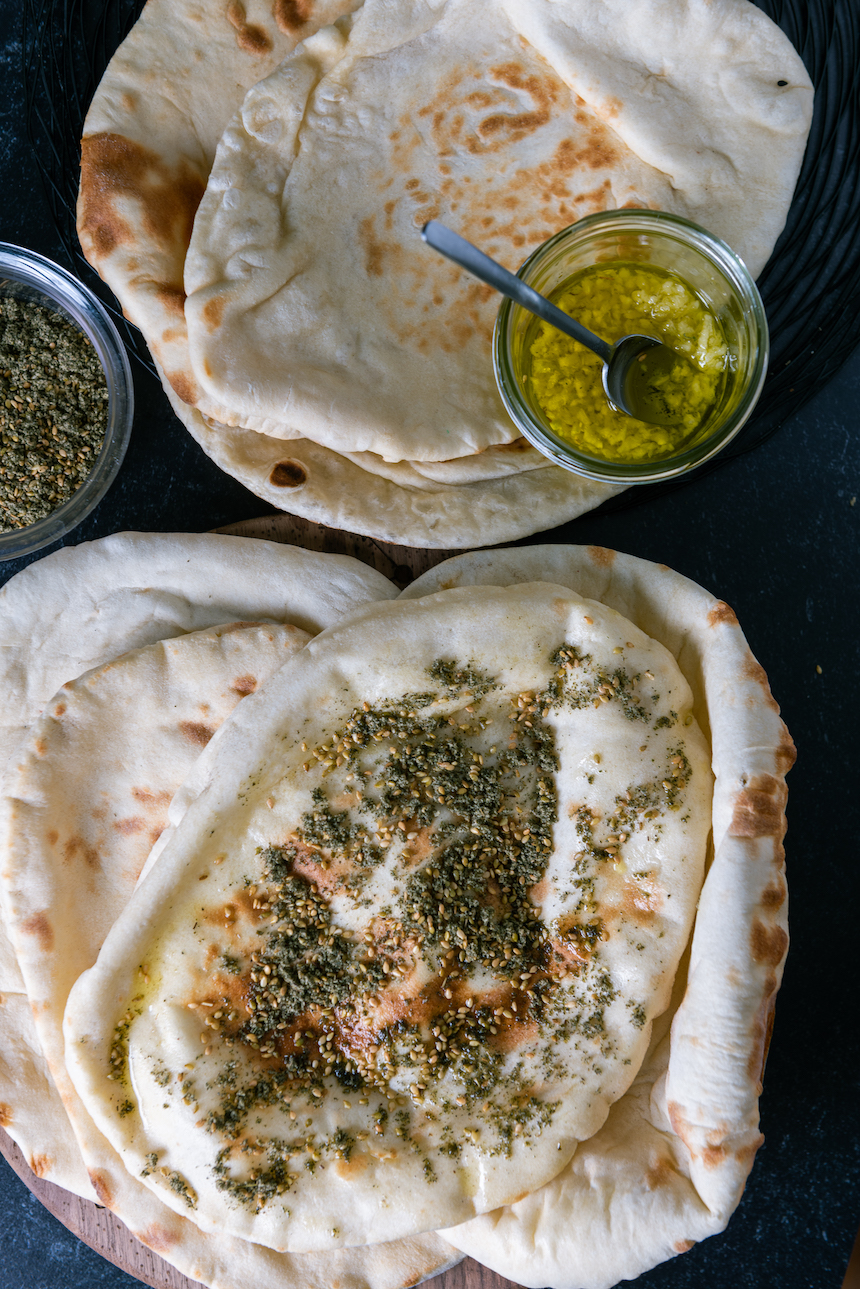
Oven-Baked Zaatar Naan

Zaatar Naan Copyright ©ShulieMadnick

In Sanskrit, tandoor, a cylindrical clay oven, was referred to as kandu. 

The word originated from the middle Persian tanûr is traced back to the Akkadian (2334 - 2218 BCE) word "tinūru, which consists of the parts tin "mud" and nuro/nura "fire" and is mentioned as early as in the Akkadian Epic of Gilgamesh.

It's a Semitic word known in the Dari Persian as tandūr and tannūr, in Armenian as t'onir, in Georgian as tone, in Arabic as tannūr, in Hebrew; tanúr, in Turkish; tandır, in Uzbek; tandir, in Azerbaijani; astəndir, and in Kurdish as tenûr, according to a Persian dictionary. 

Breads, chicken, and other foods are commonly cooked in tandoors, reaching 900 F/480 C, throughout Central Asia and the neighboring regions and Southeast Asia, including India and Pakistan. 

"Small mud plastered ovens with side openings closely resembling present-day tandoors have been excavated at Kalibangan, an Indus valley site" from the 1550 BC -3500 BC Harappan civilization period in northwest India," writes K.T.Achaya in 'A Historical Dictionary of Indian Food.

While naan and the terminology/word tandoor were brought to India by the Muslims in the 13th and 16th centuries, the archaeological excavations point to the earlier use of clay ovens as a method of baking and cooking in India. 

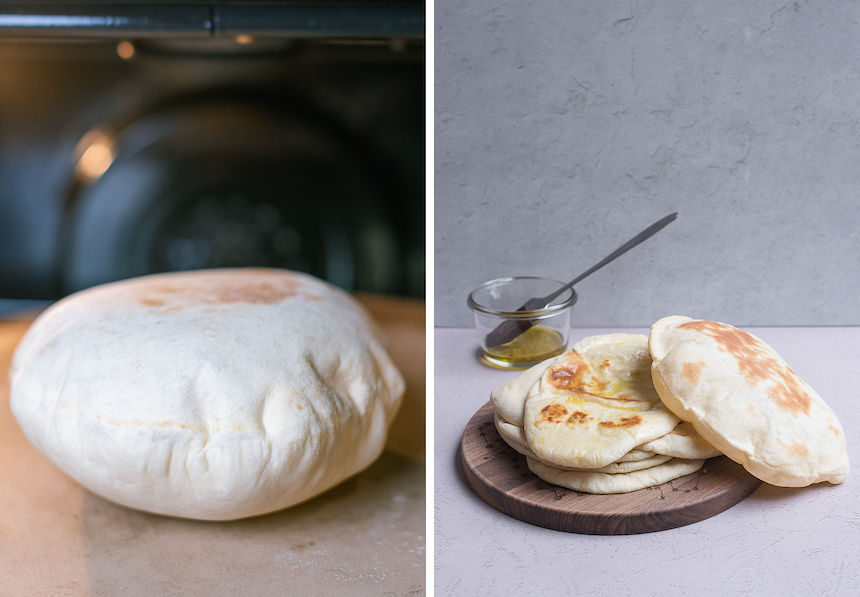
Left: Naan puffed on a pizza stone inside 550 F/288 C oven Right: oven-baked naan Copyright ©ShulieMadnick

Notes:

Peek into Cast-Iron Garlic Naan, the first post in the naan series. It might help with understanding the stove-top technique and naan's history. The cast-iron naan post also gives different visuals and links that might be helpfu in making the oven baked naan belowl.

The oven-baked naan doesn't have the dramatic blisters it forms when the naan cooks on the cast iron like in this Cast-Iron Garlic Naan, but it puffs beautifully in the oven without much fuss. 
 
 If you keep kosher, serve naan with parve, non-meat vegetarian or fish, dishes, like daal.

Oven-Baked Zaatar Naan
makes 8

this is recipe can be doubled

Ingredients:

2 1/2 cups all-purpose flour
1/2 - 3/4 teaspoon salt
2 tablespoons olive oil
1/2 cup yogurt

Cast-Iron Garlic Naan

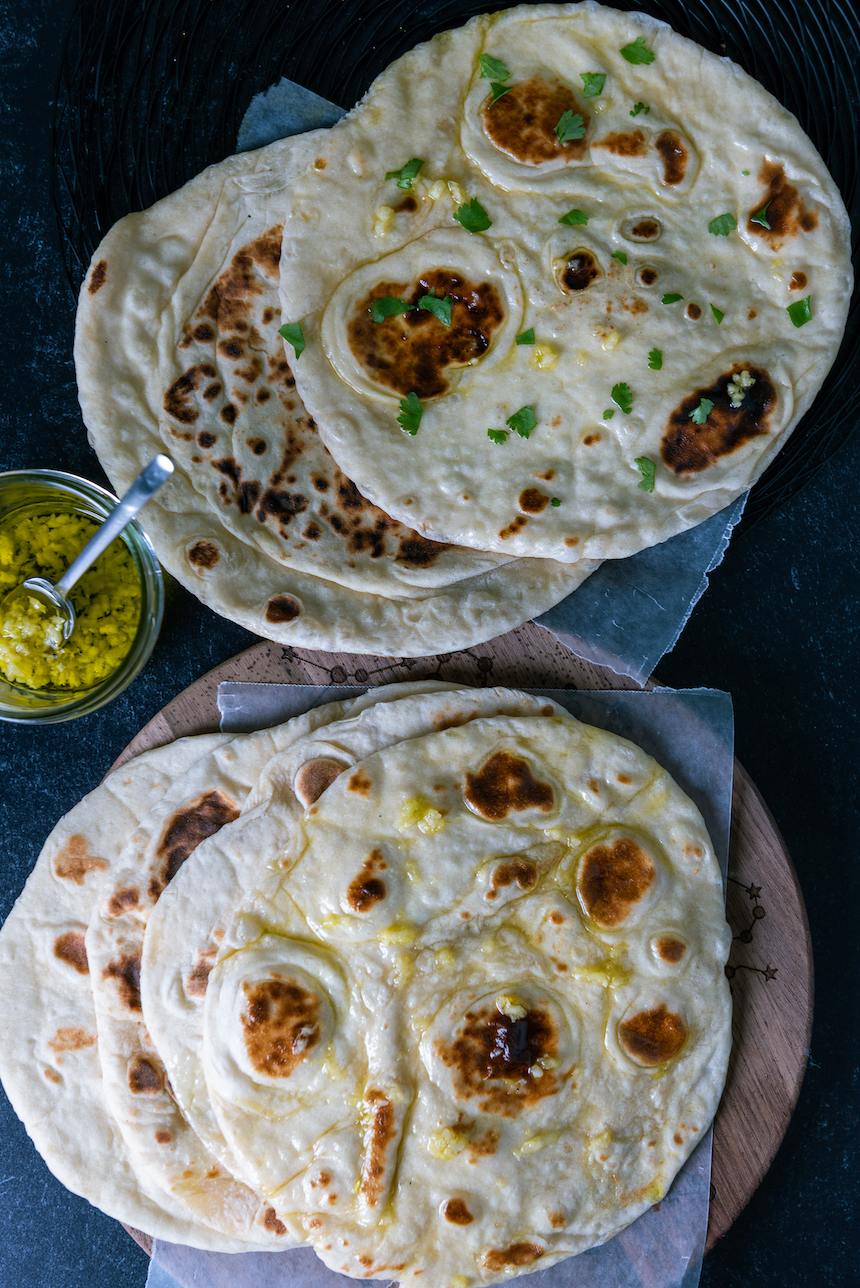
Cast Iron Naan Copyright ©ShulieMadnick

Naan in Persian means bread. The name goes by several variations, including non and nān, throughout central and southeast Asia. It's a leavened flatbread made with yeast and white flour traditionally baked in tandoor, a rounded cylindrical clay oven with a round opening at the top. The rolled-out dough is slapped onto the tandoor walls, puffs, and beautifully blisters from the coal embers at the bottom radiating 900 F/480 C heat throughout.

Naan was first mentioned in English in a 1780 travelogue,  'Russia: Or, A Compleat Historical Account of All the Nations which Compose that Empire,' written by the English clergyman William Tooke. In his travelogue, Tooke covered central Asian eating habits where he wrote, "The most common dishes are onoschi, or vermicelli; plav, or boiled rice; nan, pancakes, and the meats which the law permits."

Earlier, in 1300 AD, "naan-e-tanuk (light bread) and naa-e-tanuri (cooked in a tandoor oven) at the imperial court in Delhi" were noted in Amir Kushrau's, an Indo-Persian poet's writings. 
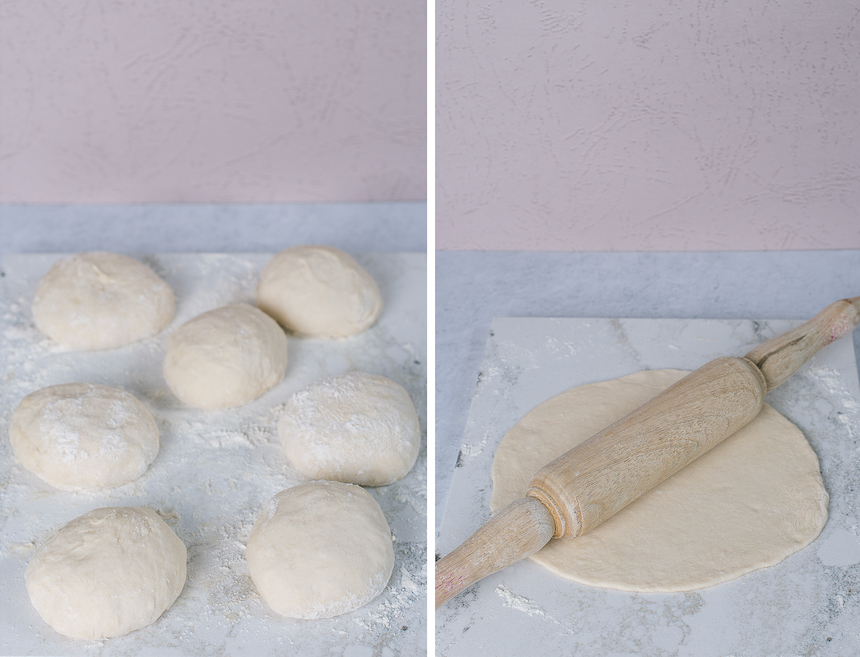
Copyright ©ShulieMadnick

The naan arrived in India with the Muslim conquerors. First in the 13th century with the Sultanate and in the 16th century with Mughals. It was un-refutably the beginning of naan's massive popularity today. However, the naan was first the food of sultans, royals, and imperial Mughals. It was consumed in the mornings with kheema (minced, no sauce, meat) and kebobs.When the royals were done with their feast the leftovers were distributed to the poor.
 Copyright ©ShulieMadnick

Notes: 

The naan dough is more supple and sumptuous, enriched with milk, ghee (clarified butter), and yogurt. It comes in many regional variations, oven-baked, traditional teardrop-shaped, and modern twists, which I will share in upcoming posts in this naan series.

The round-shaped naan fits the cast iron better. You can use a non-cast-iron pan. Ghee (clarified butter) is a traditional Indian ingredient, but often I like to use olive oil. If you keep kosher, serve naan with parve, non-meat vegetarian or fish, dishes, like daal.

Cast-Iron Garlic Naan
makes 8

This is recipe can be easily doubled 

Ingredients:

2 1/2 cups all-purpose flour
1/2 - 3/4 teaspoon salt
2 tablespoons olive oil or ghee (clarified butter)

Madagascar Vanilla Bean Ice Cream


Madagascar Vanilla Bean Ice Cream Copyright ©ShulieMadnick

Not an ice cream bit but a vanilla bit:

This past week Martha Stewart making green chocolate brownies with Snoop Dogg came across my Instagram feedWatch minute 3:20 when they add in the vanilla. I just died. Snoop Dogg goes: "Which one is the vanilla?" Martha points to the vanilla: "It's over there." Snoop Dogg: "Vanilla is burgundy (I think he said burgundy. Watch and let me know.)?" Martha Steward: "Brown. Yeah." Snoop Dogg: "Why they call it vanilla when it's..." Well, watch the rest yourselves. It's hilarious. 

Now a bit about the ice cream:

I realized that although I have posted several ice cream recipes on Foodwanderings, I haven't posted a straightforward vanilla ice cream here. Though the vanilla is the base for many of the ice creams appearing in this space. 

I will switch it up at times and use a teaspoon of pure vanilla extract instead of a vanilla bean if the ice cream is, say, rum raisin. I don't see the point of going through an entire process of splitting the bean and scraping the vanilla seeds, etc., when the end flavor I wish to achieve is rum raisin or coffee or banana-flavored ice creams, for that matter. Besides, the vanilla bean pods are super expensive. Though prices for the pure extract aren't cheap either. If I keep the ice cream a pure vanilla flavor, I use a vanilla bean. Once I didn't go and buy vanilla beans when I ran out but used the extract due to the prohibitive cost. 

But I must admit that I was at times extra fancy (which now I don't see the point) in the past and made rum raisin, salted caramel, and other flavors by adding the extra step of splitting and scraping the bean.

And if you want to learn further why vanilla is so expensive, read this piece about the politics behind vanilla and why the prices are spiked. 

I also want to discuss a bit photographing ice cream. 

It's darn frustrating. Especially if I don't use any artificial components (which I don't)  and food stylists' bags of tricks. Often the ice creams you see in magazines aren't edible. Even though I am not very happy with the photograph above. It's out of focus, in all honesty (I've been working on it all morning and gave up eventually). And artistically, I preferred the pre-cropped version of this image. But the cropped one here gives you guys a closer look at the various textures and dark speckles of the vanilla seeds. 

Madagascar Vanilla Bean Ice Cream

Ingredients:

1 1/2 cups whole milk
1 1/2 cups heavy whipping cream

Moroccan-Inspired Orange Fennel Seeds Sablé Cookies

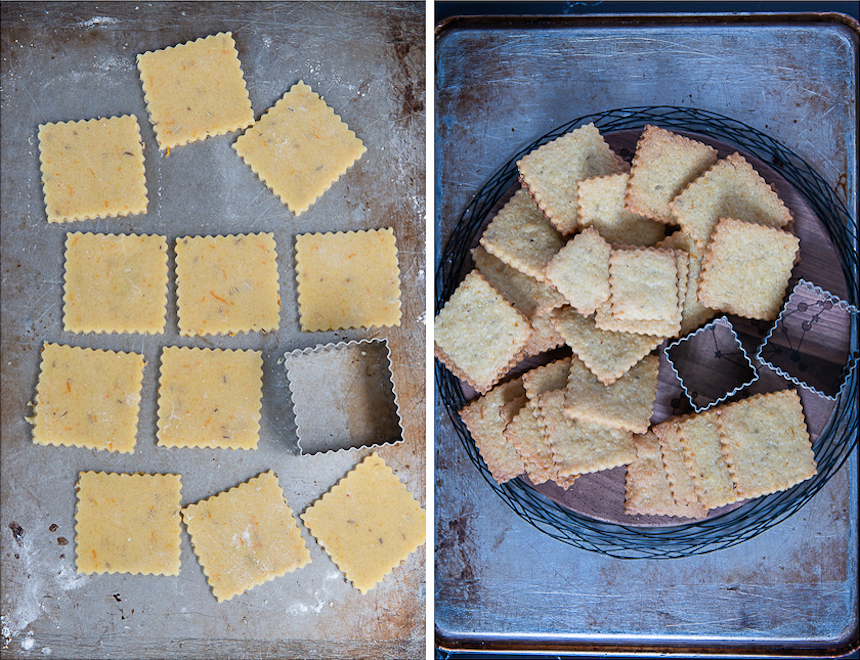
Moroccan-Inspired Orange Fennel Seeds Sablé Cookies Copyright ©ShulieMadnick

I rarely bake or buy cookies throughout the year, so it's a real treat to bake and devour cookies once a year in December. Even though we don't celebrate Christmas, I like to join the baking cookies tradition. It is so much fun, and the house smells amazing. 

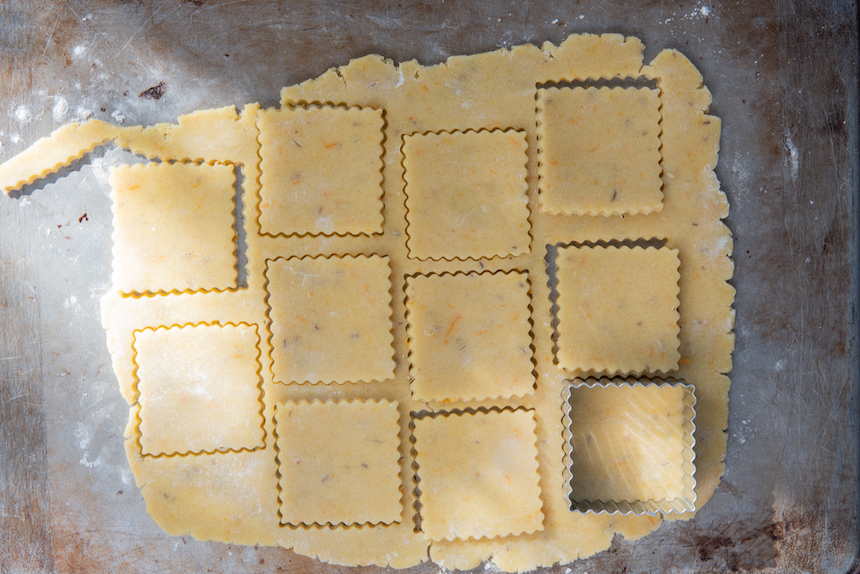
This year, I was inspired by the reifat, traditional Moroccan anise and sesame cookie. My Tunisian Israeli friend special ordered super-sized jars full of these simple yet addictive cookies from her Moroccan neighbor and I couldn't help but sneaking in one more. The reifat is thin, perforated with a fork or a dough docker cookie, It's made with baking powder and oil and is best dunked in tea, otherwise it's too dry. I wanted to give my all-time favorites, buttery sablé cookies a twist, and a Moroccan-Inspired Orange Fennel Sablé Cookies were born. 
Moroccan-Inspired Orange Fennel Seeds Sablé Cookies Copyright ©ShulieMadnick

Moroccan-Inspired Orange Fennel Seeds Sablé Cookies
makes about 32 

Ingredients:

2 sticks (8 oz) unsalted butter, room temperature
1/2 cup sugar
1/4 cup confectioners' sugar